International TrashArt Workshop in Agiasos: tradition, upcycling and environmental education
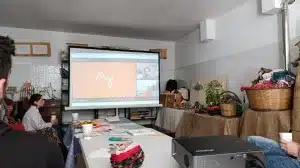
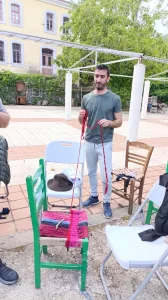
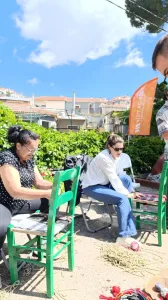
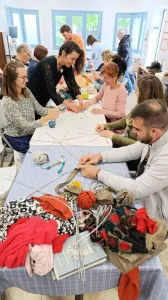
On May 17 and 18, 2025, Agiasos hosted one of TrashArt’s key international activities. The two-day workshop “Weaving with Upcycled Materials” brought together local artisanal tradition, creative reuse of materials and modern environmental education.
Old techniques, new environmental look
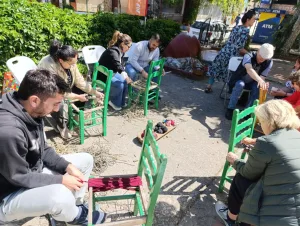
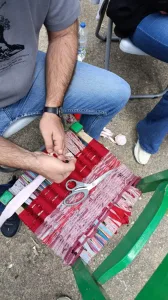
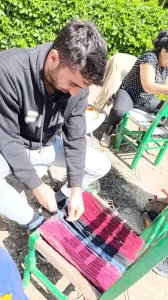
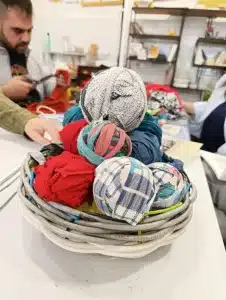
The focus was on basket weaving and chair weaving, two techniques deeply linked to the daily life of the place. Old and worn fabrics were used as raw material: participants learned to make “yarn” from old clothes, make baskets and restore traditional seats.
The workshop thus highlighted a key idea of TrashArt: that sustainability is not only about new technologies, but can also draw knowledge from traditional practices that have been based from the beginning on repair, reuse and the long life of objects.
A European meeting in Agiasos
The workshop was attended by representatives of all three project partners, from Latvia, Cyprus and Greece. Agiasos became a meeting place for different European experiences around eco-art and environmental education, with the local cultural heritage as a point of reference.
Participation
The workshop was attended by a total of 12 unique participants. The attendance registers recorded 11 entries on May 17 and 12 on May 18: the eleven participants of the first day returned and the second, where one more was added.
The continuation in Lesvos
The experience of the international workshop was not limited to Agiasos. The techniques were then transferred to local actions in Eressos (July 25, 2025) and Anemotia (August 17, 2025), as well as to educational activities with students.
Dates: 17 & 18 May 2025
Location: Agiasos, Lesvos
Participants: 12 unique participants
Instructors: Gioula Koutsoumbou & Mees Hehenkamp










Project No.: 2024-1-LV01-KA210-VET-000244372
Funded by the European Union. Views and opinions expressed are however those of the author(s) only and do not necessarily reflect those of the European Union or The State Education Development Agency (VIAA). Neither the European Union nor the granting authority (VIAA) can be held responsible for them.