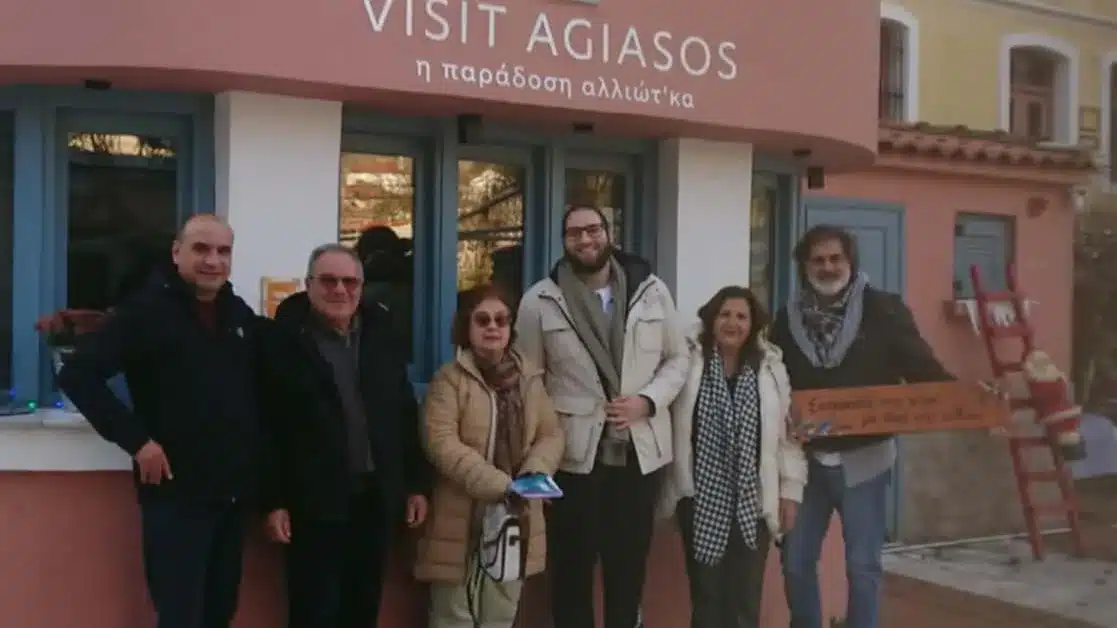
The Erasmus+ project ELCSEE – Empowering Local Communities through Social Economy Education began with a three-day kick-off meeting and initial partner training on Lesvos, hosted by Visit Agiasos as project coordinator from 9 to 11 December 2025. Partners from Greece, Cyprus and Bulgaria met with a shared aim: to support rural and local communities through education in the social economy, so that they can respond to challenges such as unemployment, isolation and the departure of young people.
ELCSEE was designed by the two Greek partners, Visit Agiasos and Social Cooperative Enterprise Kalotropio, and is implemented together with ViModo Research & Education Hub in Cyprus and Business Incubator – Gotse Delchev (BI-GD) in Bulgaria. The project addresses educators and trainers, community leaders and young people aged 18 to 30, with particular attention to small and remote communities such as Agiasos. Its planned results include an educational guide on the social economy, training activities in Greece, Cyprus and Bulgaria, and digital material presenting practical knowledge and good practice.
Key facts
Project activity: Kick-off and Initial Partner Training
Dates: 9–11 December 2025
Place: Agiasos, Mesotopos, Parakila and Mytilene, Lesvos, Greece
Host: Visit Agiasos (project coordinator)
Partners: Visit Agiasos (Greece), Social Cooperative Enterprise Kalotropio (Greece), ViModo Research & Education Hub (Cyprus), Business Incubator – Gotse Delchev (Bulgaria)
Participants: Staff of the four partner organisations, with the local social economy initiatives visited
Programme: Erasmus+ Small-scale partnerships in vocational education and training (KA210-VET)
Project: ELCSEE – Empowering Local Communities through Social Economy Education
Project number: 2025-1-EL01-KA210-VET-000356255
Day 1 – Agiasos
The partners presented their organisations, reviewed the first steps of the project and took part in a training session on the social economy ecosystem and its actors. The discussion covered the legal framework for the social economy in Greece, Cyprus and Bulgaria, and the ecosystem and challenges in each country. The partners then met three local social economy initiatives:
- Geyseis Agiasou (Γεύσεις Αγιάσου), a women’s social cooperative enterprise founded by five women of Agiasos, which preserves traditional recipes and produces handmade local products with ingredients from the Agiasos area;
- Lesvos by Locals, which offers community-based experiences that connect visitors with the daily life, traditions and cultural identity of Lesvos;
- Visit Ampeliko, which works for the social, cultural and economic revitalisation of the village of Ampeliko through community participation and the promotion of its cultural and natural heritage.
Day 1 in Agiasos: partner training, presentation of the work plan and meeting local initiatives such as Geyseis Agiasou.
Day 2 – across Lesvos
The second day combined training with field visits. Interactive sessions examined the national social economy ecosystems and how social economy initiatives can respond to real community needs. The day was also dedicated to women’s entrepreneurship, with visits to the women’s cooperatives of Mesotopos and Parakila, two long-established cooperatives that produce traditional food products. The partners learned how the cooperatives are organised and about the role they play in the economic and social life of their villages.
Day 2: the women’s cooperatives of Mesotopos and Parakila.
Day 3 – Mytilene
The third day, based in Mytilene, focused on social enterprises, digital tools and creative communication. The partners visited:
- Magikos Avlos (Μαγικός Αυλός), which works in early childhood education and creative learning, supporting children’s development and their families through innovative teaching approaches;
- Enimerosi, the news organisation behind stonisi.gr and its radio station, which is active in community journalism and digital storytelling on social and local issues of Lesvos;
- PAREA@Lesvos, a social cooperative enterprise of licensed tour guides that promotes the cultural heritage of the island through experiential tourism and cultural education.
The programme closed with hands-on training in digital storytelling, branding and visual communication, followed by a discussion of next steps and future cooperation.
Day 3 in Mytilene: visits to Magikos Avlos, stonisi.gr and local social enterprises.
Within the ELCSEE work plan
The meeting delivered the project’s Kick-off and Initial Partner Training, planned as a three-day activity hosted by Visit Agiasos. As foreseen in the approved plan, the programme combined an introduction to the social economy illustrated by cooperatives of the North Aegean, an examination of the social economy frameworks of the three partner countries and hands-on training in digital communication tools. It gave the staff of all four partners a common starting point and laid the foundations for the next stages of the project: the development of the ELCSEE educational materials, the partner trainings in Cyprus and Bulgaria, and local training in each partner country.
Erasmus+ priorities
The programme featured women-led cooperatives in small villages of Lesvos, in line with the project’s focus on inclusion and diversity. Its combination of structured training, study visits and practical work on digital communication reflects the project’s contribution to innovation in vocational education and training. The initiatives visited are built on cooperative ownership and community participation, the values at the core of the Erasmus+ priority on common values and civic engagement.
Media coverage
The start of the project was announced in the Lesvos press, including Aeolos TV (8 December 2025) and lesvosnews.net.
ELCSEE – Empowering Local Communities through Social Economy Education (2025-1-EL01-KA210-VET-000356255) is implemented under the Erasmus+ Programme of the European Union, with the support of the State Scholarships Foundation (IKY), the Greek National Agency.
Funded by the European Union. Views and opinions expressed are however those of the author(s) only and do not necessarily reflect those of the European Union or the State Scholarships Foundation (IKY). Neither the European Union nor the granting authority can be held responsible for them.