Visit Agiasos, coordinator of the Erasmus+ project ELCSEE – Empowering Local Communities through Social Economy Education, carried out the pilot implementation of the project’s educational model in Agiasos in three meetings, on 26 and 27 August and on 12 September 2026. The purpose was to test the ELCSEE approach and materials in practice with a local group, and to show how a community can move from a discussion of its needs to concrete, collective ideas.
Key facts
Project activity: Local Training – Agiasos
Dates: 26 and 27 August 2026 (19:00–21:00); 12 September 2026 (six-hour workshop)
Place: Visit Agiasos, Municipal Park of Agiasos, Lesvos, Greece, with online participation
Organiser: Visit Agiasos (project coordinator)
Partner contribution: ViModo Research & Education Hub (digital tools)
Participants: Residents, educators, representatives of local organisations and young people from across Lesvos, in person and online
Programme: Erasmus+ Small-scale partnerships in vocational education and training (KA210-VET)
Project: ELCSEE – Empowering Local Communities through Social Economy Education
Project number: 2025-1-EL01-KA210-VET-000356255
An open call to the local community
The activity was announced in the Lesvos press in August 2026 as «Τοπική Εκπαίδευση Αγιάσου» (Local Training – Agiasos). It was addressed mainly to young people aged 18 to 30, and also to local organisations, educators, active citizens and residents of Agiasos and the wider area. Places were limited and participation required registration, and people who could not attend in person were able to take part online.
The ELCSEE method
The training followed the path at the centre of the ELCSEE model: from the community and its needs, to an idea, to a social enterprise. The method starts from real needs rather than ready-made solutions, recognises the resources and knowledge that already exist locally, gives priority to cooperation and collective value creation, and weighs social benefit and economic sustainability together.
26 and 27 August – foundations and community mapping
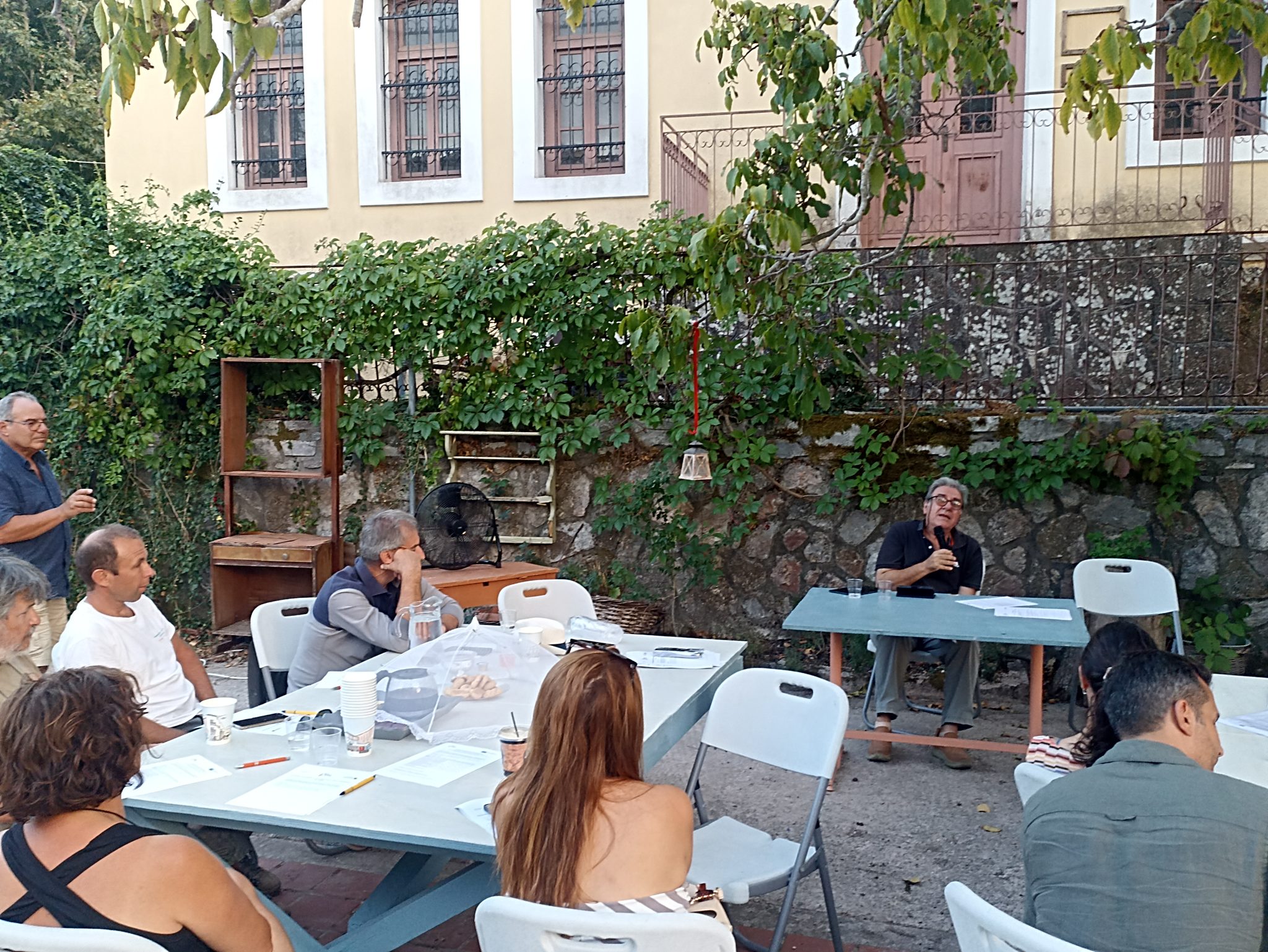
Two evening sessions laid the foundations. Participants discussed what the social and solidarity economy is, how a social enterprise differs from a conventional business, and how economic sustainability can be combined with social benefit, drawing on examples from agri-food, culture and tourism. They then mapped what the area has, what it lacks and which opportunities exist, and from there formed their first collective business ideas.
The two evening sessions of the local training at the Agiasos Municipal Park, on 26 and 27 August.
12 September – completion workshop
The six-hour completion workshop developed these ideas in depth. Working in groups, participants defined each proposal’s value proposition, beneficiaries and customers, key partners, revenue and costs, and social impact. ViModo Research & Education Hub presented practical digital tools, such as Canva, for presenting the results visually. The groups used them to design their proposals, which they then presented and improved through feedback.
The six-hour final workshop on 12 September: group work and presentation of the proposals.
Results
The groups’ proposals are being documented as case studies, to be used as educational material and as examples for other communities. The pilot also showed that the ELCSEE method is not tied to one place: it can be applied in any community or thematic field, such as culture, agri-food, care or the use of local resources, that wants to move from discussion to specific, workable ideas.
Visit Agiasos thanks everyone who took part, in person and online, and contributed their knowledge, experience and ideas.
Within the ELCSEE work plan
The pilot delivered the project’s Local Training – Agiasos, led by Visit Agiasos. The approved plan foresaw training in Agiasos for local educators, community leaders and young people aged 18 to 30, centred on a six-hour in-person session with an online component, using the ELCSEE materials and digital tools and resulting in case studies. The pilot delivered the six-hour workshop, preceded by two preparatory sessions of two hours each; it offered online participation; it used the ELCSEE materials and Canva, with the digital tools session delivered by ViModo as foreseen; and it produced group proposals that are being documented as case studies. In this way, the materials developed by the partnership were tested with members of the project’s target groups before the end of the project.
Erasmus+ priorities
The open call gave priority to young people aged 18 to 30 in a mountain community, and online participation made the training accessible to people who could not attend in person, supporting inclusion and diversity. Participants without a specialist background used a structured method to move from mapping local needs to social business models and presented their proposals with digital tools, an example of innovation in vocational education and training. Residents and local organisations worked in teams on shared ideas for local needs, reflecting the priority on common values, civic engagement and participation.
Media coverage
The training was announced and reported in the Lesvos press. The call was published by LesvosPost, lesvosnews.net, Aeolos TV and news-24.gr in August 2026, and the results were reported by Politika Lesvou, Aeolos TV and lesvosnews.net in September 2026.
</w:pBdr><w:spacing w:after=”120″ w:before=”280″ w:line=”264″/></w:pPr><w:r><w:rPr><w:rFonts w:ascii=”Calibri” w:cs=”Calibri” w:eastAsia=”Calibri” w:hAnsi=”Calibri”/><w:sz w:val=”18″/><w:szCs w:val=”18″/></w:rPr><w:t xml:space=”preserve”>ELCSEE – Empowering Local Communities through Social Economy Education (2025-1-EL01-KA210-VET-000356255) is implemented under the Erasmus+ Programme of the European Union, with the support of the State Scholarships Foundation (IKY), the Greek National Agency.
Funded by the European Union. Views and opinions expressed are however those of the author(s) only and do not necessarily reflect those of the European Union or the State Scholarships Foundation (IKY). Neither the European Union nor the granting authority can be held responsible for them.